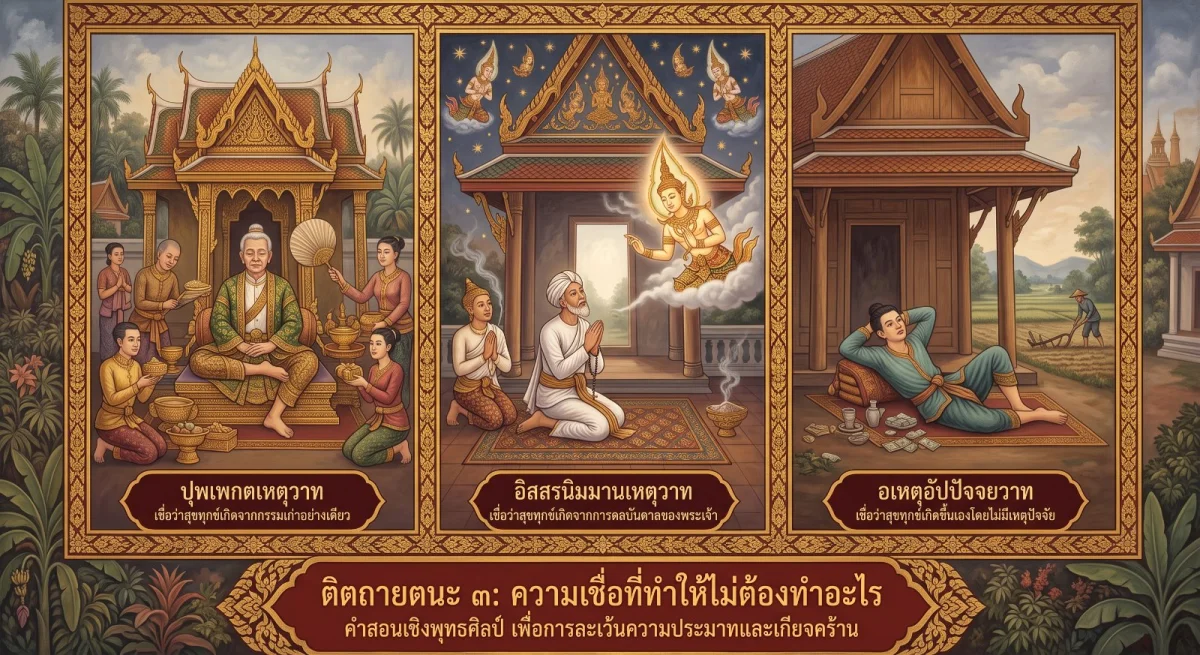
Three Sectarian Tenets: Beliefs That Lead to Inaction
ตีณิ ติตฺถายตนานิThree doctrines the Buddha rejected — everything is due to past kamma, everything is due to a creator's will, …


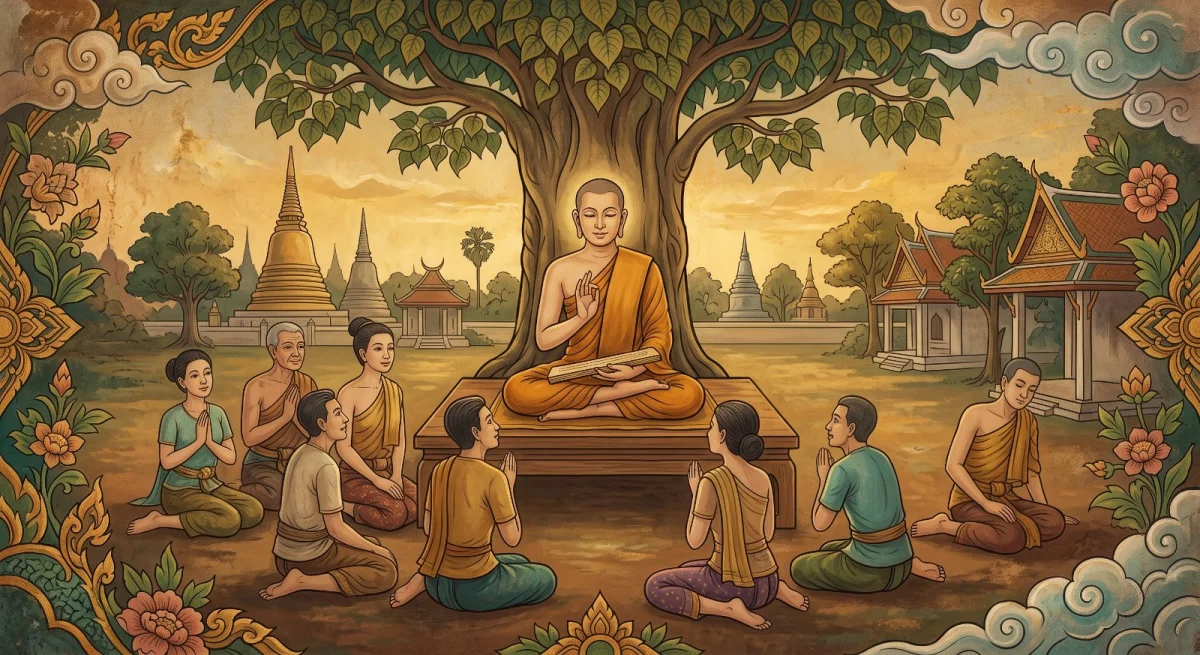
น ฉตฺตปาณิสฺส อคิลานสฺส ธมฺมํ เทเสสฺสามีติ
A monk should not teach the Dhamma to someone who is not ill and is holding an umbrella, staff or weapon, wearing footwear, riding in a vehicle, lying down or with their head covered, nor teach while sitting lower, standing, or walking behind someone. With the story of the outcaste and the brahmin teaching mantras, and the rule against having those not fully ordained recite the Dhamma word by word.
In the Vinaya Piṭaka, Mahāvibhaṅga, Sekhiya section, there is a group of sixteen training rules connected with teaching the Dhamma. They arose from the group of six teaching people whose posture showed no respect for the Dhamma, such as those holding an umbrella or weapon, wearing footwear, riding in a vehicle, or seated higher than the teacher. A monk who teaches in such circumstances out of disrespect commits an offence of wrong doing, and every rule makes an exception for a listener who is ill.
The rule about high and low seats comes with a story. The Buddha told of a time in Benares when a man the text calls an outcaste climbed the king's mango tree to get a mango for his pregnant wife. From his hiding place he saw the king sitting on a high seat learning mantras from his brahmin chaplain, who sat lower. He reflected that the learner, the teacher and he himself were all failing to act according to Dhamma.
In addition, in the Musāvāda chapter of the Pācittiya section there is a rule forbidding monks to have those not fully ordained recite the Dhamma word by word, because the group of six did this with lay followers, who then became disrespectful, lacking in deference and ill-behaved towards the monks. These rules belong to monks, but the lesson about honouring knowledge and choosing the right setting for teaching applies to everyone.
The group of six taught the Dhamma to someone holding an umbrella. Monks of few wishes criticised this and the Buddha forbade it. Later monks were reluctant to teach a sick person holding an umbrella, and people complained: why won't they teach the sick? So the Buddha allowed teaching the Dhamma to a sick person with an umbrella in hand.
Whenever you set a standard of proper conduct, always leave room for people who are ill or struggling. Don't let a rule become a reason to abandon someone who needs help.
The Buddha laid down that one should not teach the Dhamma to someone who is not ill and is holding a staff, a blade (an edged instrument for striking), or a weapon, which the analysis explains as a bow or similar missile weapon.
If you need to discuss something sensitive, choose a time when the other person can put down what they're holding, whether that's the work in their hands or a mood that's still simmering.
The Buddha laid down that one should not teach the Dhamma to someone not ill who is wearing sandals or shoes, riding in a vehicle, lying down (even on the ground), sitting clasping the knees, wearing a turban that hides the hair, or with the head covered. For the turban and covered head, it is allowed if one has them uncover the head first.
When listening to a teacher or someone you want to learn from, set your posture to receive: take out your earphones and sit up. Posture helps the mind get ready too.
The Buddha laid down that a monk should not teach the Dhamma while sitting on the ground to someone on a seat, while on a low seat to someone on a high seat, while standing to someone sitting, while walking behind to someone walking ahead, or while walking beside the path to someone on the path. Each rule excepts a listener who is ill.
If you have something important to explain, don't chase after someone talking while they walk away or do something else. Ask for time to sit down and talk properly.
The man hiding in the mango tree saw the king seated high learning mantras while the brahmin sat low teaching them. He thought the king was not respecting Dhamma, the brahmin was not respecting Dhamma, and he himself, stealing the king's mango for a woman's sake, was not respecting Dhamma either. He spoke a verse saying that neither of them knew the meaning or saw the Dhamma. The brahmin replied that because he ate fine rice with meat sauce, he did not live by the Dhamma. The man then condemned gaining wealth and fame through wrongful livelihood. The Buddha said that even back then, a brahmin sitting low to teach one seated high did not please him.
When you see someone else's fault, ask yourself as this man did whether you are acting rightly too. Owning your part gives your warning more weight.
The group of six had lay followers recite the Dhamma word by word, and as a result the lay followers were disrespectful, lacking in deference and ill-behaved towards the monks. So the Buddha made it an offence entailing confession (pācittiya). The analysis explains several forms of word-by-word recitation, such as starting together and finishing together, and defines Dhamma as what was spoken by the Buddha, by disciples, by sages and by deities. Exceptions include reciting or studying together, and when the person recites a text they already mostly know fluently. The text does not explain why this method made the lay followers disrespectful.
When you teach someone, watch the effect on the relationship, not only whether the content gets across. If a teaching method starts making learners value what they learn less, rethink the method.
These rules do not say that people holding umbrellas or wearing shoes are bad. They say the Dhamma is precious, so it should be taught where the listener is ready to receive it, and the teacher should not diminish what is being taught. The exception for the sick in every rule shows that respect for the Dhamma does not override kindness to those in difficulty.
In everyday life, teachers, managers and parents who want to pass on something important can learn from this that important things shouldn't be tossed off in passing or said when the other person isn't ready to listen. Waiting for the right moment and setting the scene well honours both the listener and the content.
Tap to read the actual passage on the page cited.
Three doctrines the Buddha rejected — everything is due to past kamma, everything is due to a creator's will, …

When an old monk rejoiced at being free of restrictions, Mahākassapa called on the Saṅgha to recite the Dhamma…

Practice guidelines from the Tuvaṭaka Sutta: cut the root of proliferation, the conceit "I am"; don't be arrog…

One who has not yet realised the Dhamma but has unwavering confidence that these things are impermanent is cal…