
Verses of Pussa: A Mirror for Future Renunciants
ปุสฺสตฺเถรคาถาThe sage Paṇḍarasa asks what monks will be like in future. The elder Pussa answers that many will be angry, pr…


จูฬกมฺมวิภงฺโค
The Buddha's answer to why people are born so differently — seven pairs of cause and result, from the Cūḷakammavibhaṅga Sutta.
The young brahmin Subha asked why human beings differ so much: in lifespan, health, appearance, influence, wealth, family and intelligence. The Buddha answered with a line that sums up the whole teaching on kamma: beings are owners of their actions, heirs to their actions, born of their actions.
He then analysed it into seven pairs, showing which kind of action leads to which kind of result. What repays careful reading is that all seven are things anyone can choose in the present — not an explanation designed to make people accept their lot.
One given to killing and harming living beings tends towards a short life; one who abstains from killing and has kindness towards all beings tends towards a long one.
In daily terms this begins with not harming other lives or your own — sleep, food, and not damaging your body with accumulated stress.
One given to hurting and injuring others tends towards frequent illness; one who does not injure tends towards good health.
Practise laying down harm in deed and in speech, and notice your own body relax — resentment consumes the health of whoever carries it first.
One often angry, irritable and openly hostile tends towards an unattractive appearance; one not given to anger tends towards a bright one.
This one shows day to day. Compare your face after a day of anger with your face after a day of calm, and the meaning becomes obvious.
One with an envious heart, displeased when others do well, tends towards having little influence; one free of envy and glad at others' success tends towards having much.
Make gladness a habit: when someone does well, say one sincere line of congratulation. Those who can rejoice at others' success keep getting drawn into circles that grow.
One who does not give and is stingy tends towards small means; one who gives tends towards great means.
Start with giving you can genuinely sustain each month, however small. The habit of giving builds relationships and opportunities — the long-run sources of wealth.
One who is stiff with pride and does not honour those worthy of honour tends towards birth in a humble family; the humble tend towards birth in a respected one.
Humility at work is the same principle with immediate results. Those who show respect at every level get supported by more people than they realise.
One who never approaches those who know to ask what is wholesome and what is not tends towards weak discernment; one who asks regularly tends towards strong discernment.
Make a habit of asking good questions of people who really know, at least once a month. Wisdom doesn't come from sitting still; it comes from going and daring to ask.
Use this looking forward, not backward to assign blame: each pair says that if you want a certain result, begin the corresponding cause today.
Just as importantly, don't use kamma to judge another person's suffering as "deserved". In the Mahākammavibhaṅga Sutta the Buddha warned plainly that even those with the divine eye draw mistaken conclusions about others' kamma, because results unfold across time in ways the eye cannot follow.
Tap to read the actual passage on the page cited.
The sage Paṇḍarasa asks what monks will be like in future. The elder Pussa answers that many will be angry, pr…

The Nikkhepa section defines the sutta-style pairs: what being difficult to admonish is, what bad friendship i…
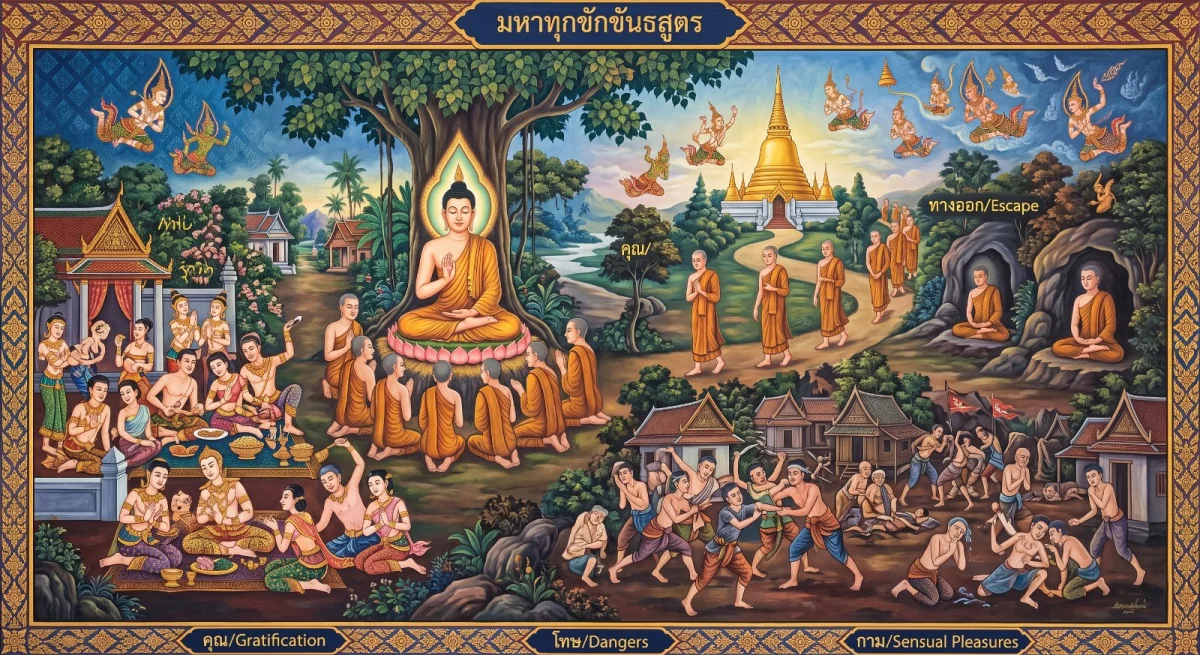
Everything has three sides to see in full — what is gratifying, what is dangerous, and the way out. The Buddha…

Generosity, virtue, renunciation, wisdom, energy, patience, truthfulness, determination, loving-kindness and e…