
The Admonisher Jātaka: Good Only at Teaching Others
AnusāsikajātakaṃA bird who kept warning others not to feed on the cart road secretly fed there herself out of greed, until a c…


Gopakamoggallānasuttaṃ
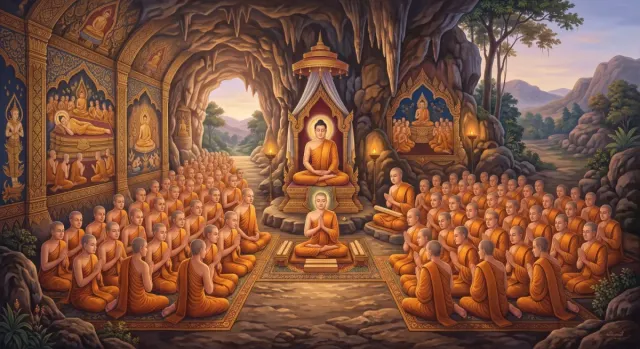
Shortly after the Buddha's passing, a brahmin asks Ānanda who the successor is. The answer is that there is none — neither appointed by the Buddha nor elected by the elders. What holds the community together is the Dhamma, and respect for those who genuinely have the qualities.
In the Gopakamoggallāna Sutta of the Majjhima Nikāya, the setting is shortly after the Buddha's final passing. Venerable Ānanda is staying at the Bamboo Grove near Rājagaha. The brahmin Gopaka Moggallāna asks whether there is any single monk who possesses in every way all the qualities the Buddha possessed. Ānanda says there is none, for the Buddha aroused the path that had not arisen, declared the path that had not been declared, and knew and was skilled in the path, while the disciples now follow that path and come to possess those qualities afterwards.
Vassakāra, chief minister of Magadha, joins them and asks further: is there a monk appointed by the Buddha to be their refuge after his passing? Or one elected by the Saṅgha and the senior elders? Ānanda says there is neither. The brahmin then asks what, with no refuge, can be the cause of concord. Ānanda answers that they are not without a refuge: the Dhamma is their refuge.
He then explains what that means concretely. The Buddha laid down training rules and set forth the Pātimokkha. On each observance day all the monks living near one village gather, invite one who can recite it to recite, and if an offence or transgression appears, they deal with it according to the Dhamma and as instructed. So he says: it is not the venerable ones who make us act — it is the Dhamma that makes us act. And asked whether there is anyone they still honour and respect, he says yes: whoever has the ten qualities inspiring confidence that the Buddha declared.
Ānanda says no single monk possesses in every way all the qualities the Buddha possessed, because the Blessed One aroused the path that had not arisen, gave rise to the path not yet given rise to, declared the path not yet declared, knew the path and was skilled in it — while the disciples now follow the path and come to possess those qualities afterwards.
Being the first to find the way and being someone who walks it well are two different abilities. There is no need to feel lesser for being the second.
The brahmin asks on two levels: is there a monk appointed by the Buddha as a refuge after his passing, and is there one elected and appointed by the Saṅgha and many senior elders? Ānanda answers that there is none in either case.
When a leader leaves, don't rush to find someone to fill every part of the old role. First work out what actually needs to be preserved.
Asked what, with no refuge, can be the cause of concord in accordance with the Dhamma, Ānanda answers that they are not without a refuge — they have a refuge: the Dhamma is their refuge.
Let the stability of a group rest on clearly stated values and agreements, not on who currently holds the top job.
Ānanda explains concretely: the Buddha laid down training rules and set forth the Pātimokkha. On each observance day, all the monks living near one village gather together and invite one who can recite it to do so. If a monk with an offence or transgression appears, they have him deal with it according to the Dhamma and as instructed. So he says: it is not the venerable ones who make us act; it is the Dhamma that makes us act.
Set the rules in advance and review them together regularly, so that when something must be addressed it does not become a personal matter between two people.
Ānanda says there are monks they honour, respect, revere and live in dependence on: those who have the ten qualities inspiring confidence. The list begins with being virtuous, restrained by the Pātimokkha, seeing danger in the slightest fault; being very learned and retaining well what has been heard; and being content with the four requisites. The remaining ones concern the jhānas and the higher knowledges up to the destruction of the taints.
When choosing whom to listen to, look at conduct you can check, real knowledge and freedom from greed — rather than at position or follower counts.
Vassakāra turns to the general Upananda and says that these venerable ones honour what should be honoured, respect what should be respected, revere what should be revered, worship what should be worshipped; and if they did not honour this, what else would they honour and live in dependence on?
Ask yourself whether what you give most of your day to is actually worth the time you give it.
Vassakāra asks whether the Bamboo Grove is delightful, quiet and fit for seclusion. Ānanda replies that it is so because of protectors and guardians like him. The brahmin replies that it is so rather because of venerable ones like them, who meditate and make a habit of meditation.
In work done together, give the other person credit first. Sincere credit exchanged both ways is what makes long collaboration possible.
Ānanda says the Blessed One neither praised every kind of meditation nor refrained from praising every kind. What he did not praise: someone whose mind is obsessed by sensual desire, ill will, dullness and drowsiness, restlessness, or doubt, who does not understand the escape from it, and who meditates with that very thing inside. What he praised are the four jhānas born of seclusion.
Sitting quietly is not always good. If sitting only turns the same unresolved thing over and over, get up and walk, or change the object of meditation first.
This discourse answers a question every organisation eventually faces: when the founder or the leader everyone trusted is gone, what holds people together? The answer is not to rush someone into the role, but to have rules that were agreed on clearly, reviewed together regularly, and applied equally to everyone.
The line that the Dhamma is what makes them act is what keeps a community from becoming a matter of personal power. When someone breaks the agreement, it is not that one individual punishes at will; it follows the agreement everyone knew in advance.
At the same time, the discourse does not reject respecting people — it changes the criterion, from respect for position to respect for qualities that can be checked, such as being virtuous, learned and content with little.
Tap to read the actual passage on the page cited.
A bird who kept warning others not to feed on the cart road secretly fed there herself out of greed, until a c…
When an old monk rejoiced at being free of restrictions, Mahākassapa called on the Saṅgha to recite the Dhamma…

The four truths at the heart of every teaching, laid out the way a doctor works: name the symptom, find the ca…

For those standing in mid-stream as a fearful flood arises, overwhelmed by aging and death, what island can th…