
Daily chants
Requesting and undertaking the five precepts
PañcasīlasamādānaṃThe request for the precepts from a monk, followed by the undertaking of the five training rules one by one — …


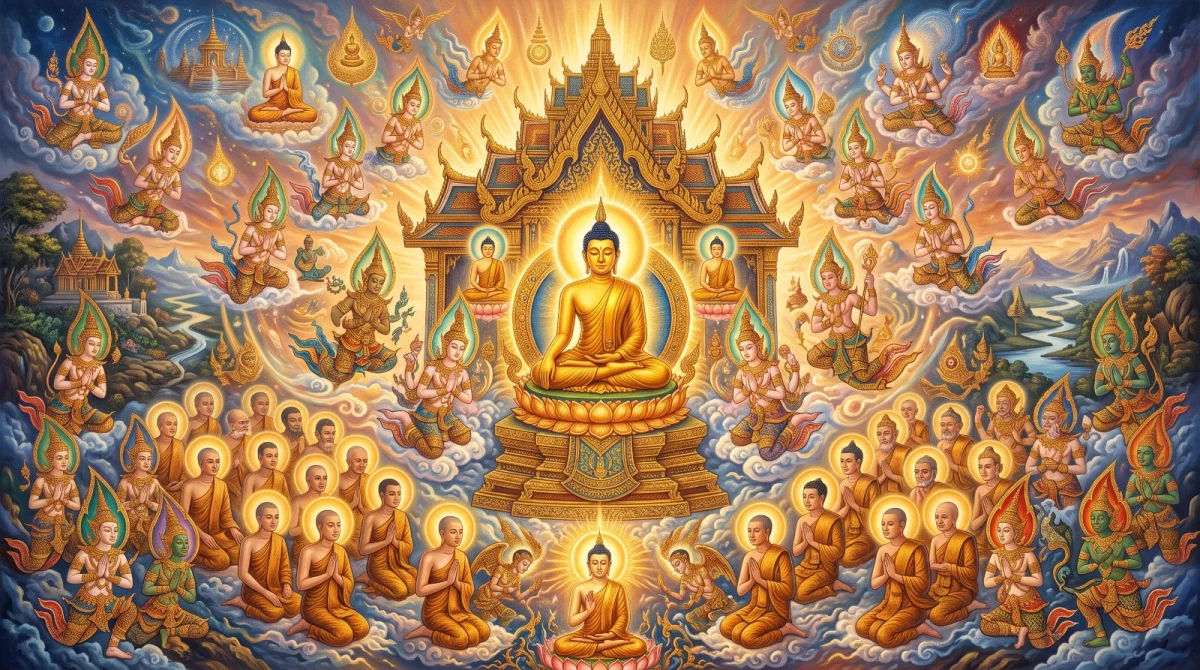
Jinapañjaragāthā
An old Thai composition, not part of the Tipiṭaka, which places the Buddhas and the great disciples around the body as a way of calling their qualities to mind.
Commonly chanted in the morning after the daily chanting or before leaving the house, and at night to settle the mind.
Some people chant it before something they are anxious about — an exam, an operation, a long journey. What it gives is a steadier mind from recollecting what is wholesome; it is not a guarantee that nothing will go wrong, and it is not a substitute for medical care or ordinary preparation.
The Jinapañjara is not part of the Tipiṭaka. It is a Pali composition written later, and the version Thai people know is attributed to Somdet Phra Phutthachan (To Phrommarangsi), who arranged or revised it in the early Bangkok period. He died in 1872, so the text is old and freely used.
The title means the cage or enclosure of the Victors. The picture it paints is of the chanter seated inside a circle of the twenty-eight Buddhas of the past and the eighty great disciples, each invited to take a place around the body, with the major parittas — the Ratana, Metta, Dhajagga, Aṅgulimāla, Khandha, Mora and Āṭānāṭiya — forming a wall around the whole.
In substance it is a review of who and what one holds in mind. Picturing oneself surrounded by teachers keeps the mind from scattering and makes it harder to shake. The effect is on the chanter's own mind — which is what the Dhajagga Sutta describes when it says that recollecting the Triple Gem makes fear fade.
Click to read the actual page it refers to
The request for the precepts from a monk, followed by the undertaking of the five training rules one by one — …

The words for offering a meal to the Saṅgha at a service dedicated to parents and relatives who have died.
A short homage to the Buddha, the Dhamma and the Saṅgha, chanted before other chants or before meditation.

The verses praising the qualities of the Buddha, the Dhamma and the Saṅgha, in the wording found in the Dhajag…